If you’ve been dyeing fabric for a while, you’ve probably noticed that the dye itself gets all the credit — and all the budget planning. But ask anyone who’s scaled from kitchen-table tie-dye to a consistent studio practice, and they’ll tell you the same thing: the auxiliary chemicals are where results live or die. Auxiliary chemicals are the supporting cast of a dye bath — substances like urea (a humectant that keeps fiber moist so dye can bond), soda ash (an alkali that raises pH so fiber-reactive dyes can actually fix to cotton), Synthrapol (a surfactant that removes excess unfixed dye in the wash), and Retayne (a cationic fixative that traps dye molecules inside washed fabric). None of them are glamorous. All of them matter. This article breaks down the four most consequential auxiliaries for fiber-reactive and direct-dye workflows — what each one does chemically, when it earns its cost, and when you can skip it without consequence.
Soda Ash: The Non-Negotiable Starting Point
If there’s one auxiliary that isn’t optional for Procion MX and other fiber-reactive dyes on cellulose fiber (cotton, linen, rayon, hemp), it’s soda ash — sodium carbonate. The chemistry is straightforward: fiber-reactive dyes form a covalent bond with cellulose, but that reaction only happens at high pH. Soda ash raises your dye bath or pre-soak to roughly pH 10.5–11, which is the activation window.
Two application methods, two different results.
The first method — pre-soaking fabric in a soda ash solution (typically 1 cup per gallon of warm water) for 15–20 minutes before dyeing — is the standard for tie-dye and direct-application techniques. The second method — adding soda ash directly to the dye bath after the fabric has had time to absorb dye — is more common in immersion dyeing, where it gives you a longer working window before fixation begins.
Why does this distinction matter? Because once soda ash hits the dye bath, the clock starts. Fiber-reactive dyes begin bonding to whatever cellulose is in range — fabric, yes, but also water molecules, which hydrolyzes (deactivates) the dye. If you’re doing detailed work or batik resist, adding soda ash too early means your dye exhausts before you’ve finished painting. Pre-soaking the fabric separately keeps your dye bath stable longer.
Per Dharma Trading Co.’s fiber-reactive dye instructions, the pre-soak method works well for most tie-dye and direct-application projects, while the “add soda ash to the bath” method suits exhaust dyeing in a bucket or washing machine.
Cost checkpoint: Soda ash runs roughly $0.50–$1.50 per pound from bulk dye suppliers like Dharma, PRO Chemical & Dye, and Jacquard. At a typical use rate of 1 cup per gallon of pre-soak, a 5-pound bag covers dozens of medium-sized project batches. There is no cost argument for skipping it — the dye won’t fix properly without it on cellulose, and the fabric will bleed catastrophically in the first wash.
Urea: The Humidity Workaround You Actually Need in Dry Conditions
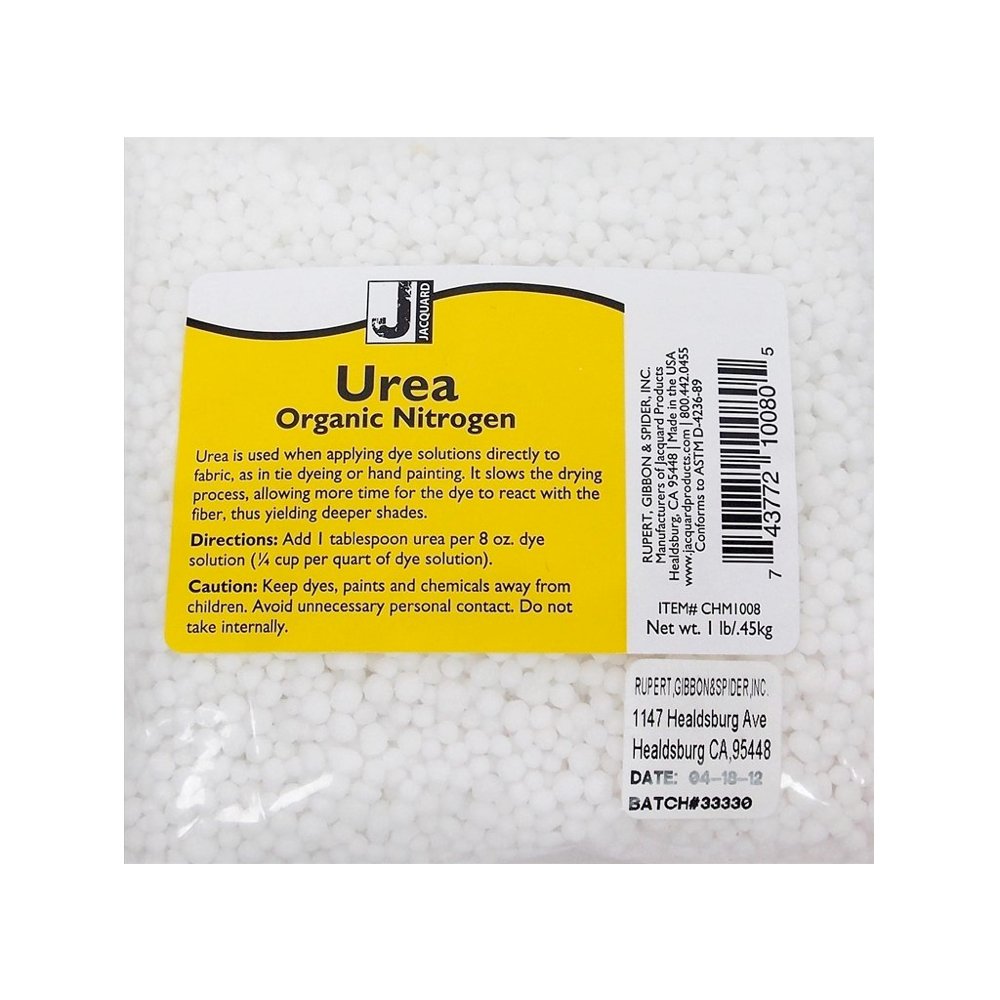
Urea is a humectant — it attracts and holds moisture. In fiber-reactive dyeing, moisture is the medium through which dye molecules travel into fiber and complete their bond. If your fabric dries out during the cure period (the 12–24 hours after application when fixation is happening), the reaction stops early, and you get pale, uneven results.
This is where urea earns its place. Dissolved in your dye stock solution — Dharma Trading Co.’s documentation suggests roughly 1–2 tablespoons per cup of warm water when mixing dye concentrate — urea keeps the dye paste or liquid workable for longer and helps the dye migrate into fiber more evenly before fixation begins.
When urea is essential vs. when it’s redundant:
- Low-humidity climates or heated indoor studios in winter: Urea is genuinely worth adding. Without it, fabric wrapped in plastic can still dry faster than expected, especially at the edges of a tightly bundled tie-dye piece.
- Direct-application silk painting or immersion dyeing: Less critical. Silk and immersion processes have enough moisture in the system that humectancy is rarely the limiting factor.
- High-humidity summer conditions: Many experienced dyers report skipping urea entirely during humid months with no degradation in results, per aggregated community feedback documented in Dharma’s FAQ pages.
A practical note on urea and color depth: Some dyers use higher urea concentrations specifically to achieve deeper saturation on dense fabrics like canvas or heavyweight denim. The urea allows dye molecules to penetrate further into the fiber structure before the reaction completes. PRO Chemical & Dye’s auxiliary chemical documentation notes this effect, particularly for large-yardage immersion work.
Urea is inexpensive — typically $2–$4 per pound from dye suppliers — and a pound goes a long way. The question isn’t whether you can afford it; it’s whether your working conditions make it necessary.
Synthrapol: The Wash Step That Protects Everything Downstream
Synthrapol is a pH-neutral surfactant (a type of detergent) designed for two jobs: pre-washing fabric to remove sizing, oils, and finishes before dyeing, and post-wash rinsing to remove unfixed dye from finished work.
The post-wash function is where Synthrapol does its most important work. Any fiber-reactive dyeing process leaves some percentage of hydrolyzed (deactivated) dye molecules in the fabric — dye that bonded to water instead of fiber and is now just sitting in the textile, unfixed. If you wash finished work in a standard detergent without Synthrapol, that loose dye bleeds into the wash water and can redeposit on light areas of your own piece or on other items in the machine. Synthrapol keeps those particles in suspension so they rinse out cleanly.
By the numbers:
| Application | Synthrapol dose | Water temp |
|---|---|---|
| Pre-wash (remove sizing) | 1 tsp per gallon | Warm (100–120°F) |
| Post-dye rinse, first pass | 1 tsp per gallon | Cold (stops bleeding faster) |
| Post-dye hot rinse | 1 tsp per gallon | Hot (140°F, removes stubborn hydrolyzed dye) |
Per Jacquard Products’ Procion MX technical data, a hot Synthrapol wash after cold rinsing is particularly important for dark, saturated colors — navy, black, deep red — where the dye load is high and hydrolyzed dye volume is proportionally larger.
Is Synthrapol actually necessary, or is a hot soapy rinse equivalent? The Surface Design Association’s journal coverage of dye chemistry for textile artists notes that while a very hot wash with a pH-neutral detergent can approximate some of Synthrapol’s function, Synthrapol’s formulation is specifically designed to handle the particle size and ionic charge of fiber-reactive dye molecules. For production-scale work where cross-contamination between colorways is a real cost risk, it’s the professional-grade choice. For a one-off tie-dye project going into its own wash cycle, a rigorous hot rinse sequence with a gentle, dye-free detergent may be sufficient.
Synthrapol runs $8–$15 for a 4-oz bottle and $20–$35 for a quart from Jacquard and PRO Chemical & Dye. At the recommended dilution rates, a quart covers a substantial volume of fabric processing.
Retayne: The Right Tool for a Specific (and Underappreciated) Problem
Retayne is a cationic (positively charged) dye fixative designed specifically for commercially dyed fabrics that bleed. If you’ve ever washed a purchased red or navy garment and watched the water turn pink or blue, you’ve experienced the problem Retayne solves.
Here’s the chemistry in plain terms: many commercial dyes — direct dyes, in particular — don’t form a covalent bond with fiber the way Procion MX dyes do. They sit inside the fiber structure held by weaker attractive forces, and heat and agitation in the wash dislodge them. Retayne is a substantive dye fixative that creates an additional ionic attraction between these loosely held dye molecules and the fiber, reducing bleed.
What Retayne is not: It is not a fixative for fiber-reactive dyes you’ve applied yourself. If your Procion MX work is bleeding in the wash, the problem is almost certainly inadequate soda ash fixation, insufficient cure time, or an incomplete post-wash rinse — not a gap that Retayne fills. Dharma Trading Co.’s Retayne FAQ makes this distinction explicitly: Retayne is for pre-existing commercially dyed fabrics, not for improving the washfastness of home-dyed fiber-reactive work.
Where Retayne earns its spot in the studio:
- Quilters working with commercial solids or prints in high-contrast colorways where a bleeding red could ruin adjacent light fabrics
- Indie apparel brands sourcing blank garments and needing to pre-treat before overdyeing or patchwork construction
- Shibori and resist-dye artists layering commercial fabric with home-applied dye, where the base fabric’s colorfastness matters to the final result
Application requires heat: Retayne treatment is typically done in a hot water bath (around 140°F) with the fabric agitated for 20 minutes, then rinsed. PRO Chemical & Dye’s auxiliary documentation notes that the cationic chemistry works best when the bath is held at temperature — a slow-cooker or stainless pot on a burner works better than a standard washing machine for controlled heat.
Retayne runs approximately $8–$14 for a 4-oz bottle, sufficient for treating several yards of fabric.
The Decision Frame: Which Auxiliaries Do You Actually Need?
By this point in a dye practice, the temptation is to buy everything once and sort out necessity later. That’s not unreasonable — the per-unit costs are low — but understanding the conditional logic helps you prioritize.
If you’re dyeing natural cellulose fiber with Procion MX or any fiber-reactive dye:
- Soda ash: mandatory, no substitution
- Synthrapol: high value at scale or for dark colors; approximable with hot rinses for single projects
- Urea: conditional on humidity, fabric weight, and technique
- Retayne: not relevant to your dye chemistry here
If you’re working with commercially dyed fabric that bleeds:
- Retayne: the direct-purpose tool
- Synthrapol: still useful in the wash step
- Soda ash / urea: not applicable
If you’re scaling to production volume: All four become line items, not luxuries. At bulk pricing — Dharma Trading Co. and PRO Chemical & Dye both offer pound-quantity pricing on soda ash, urea, and Synthrapol — the per-project cost of running a complete auxiliary protocol drops below $0.50 for a medium garment batch. The cost argument for cutting auxiliaries at production scale dissolves quickly when you factor in the cost of re-dyeing or replacing work that faded or bled.
The honest summary is this: dye chemistry is a system, and auxiliaries are not the expensive part of the system. Getting them right is what makes the expensive part — the dye, the fiber, the labor — actually hold.