If your freshly dyed fabric looks brilliant coming off the table and then comes out of the washing machine looking like a pale imitation of what you made, you’re not alone — and you probably don’t need better dye. What you’re running into is a colorfastness failure: the dye didn’t bond permanently to the fiber. Colorfastness just means how well color holds up to washing, light, and friction. For most home and studio dyers working with fiber-reactive dyes — the dye class used for natural fibers like cotton, linen, and rayon — permanent color requires a chemical bond between the dye molecule and the fiber itself. That bond doesn’t happen automatically. It needs an alkaline environment (that’s what soda ash provides), enough time at the right temperature to complete the reaction (cure time), and a wash protocol that removes loose dye without stripping the bonded color. Miss any one of those three, and the wash steals your work.
This article walks through each variable, names the tradeoffs, and ends with a decision framework you can apply to your next project — whether you’re troubleshooting a batch that went wrong or setting up a repeatable protocol for production work.
What Soda Ash Is Actually Doing (and What It Can’t Do)
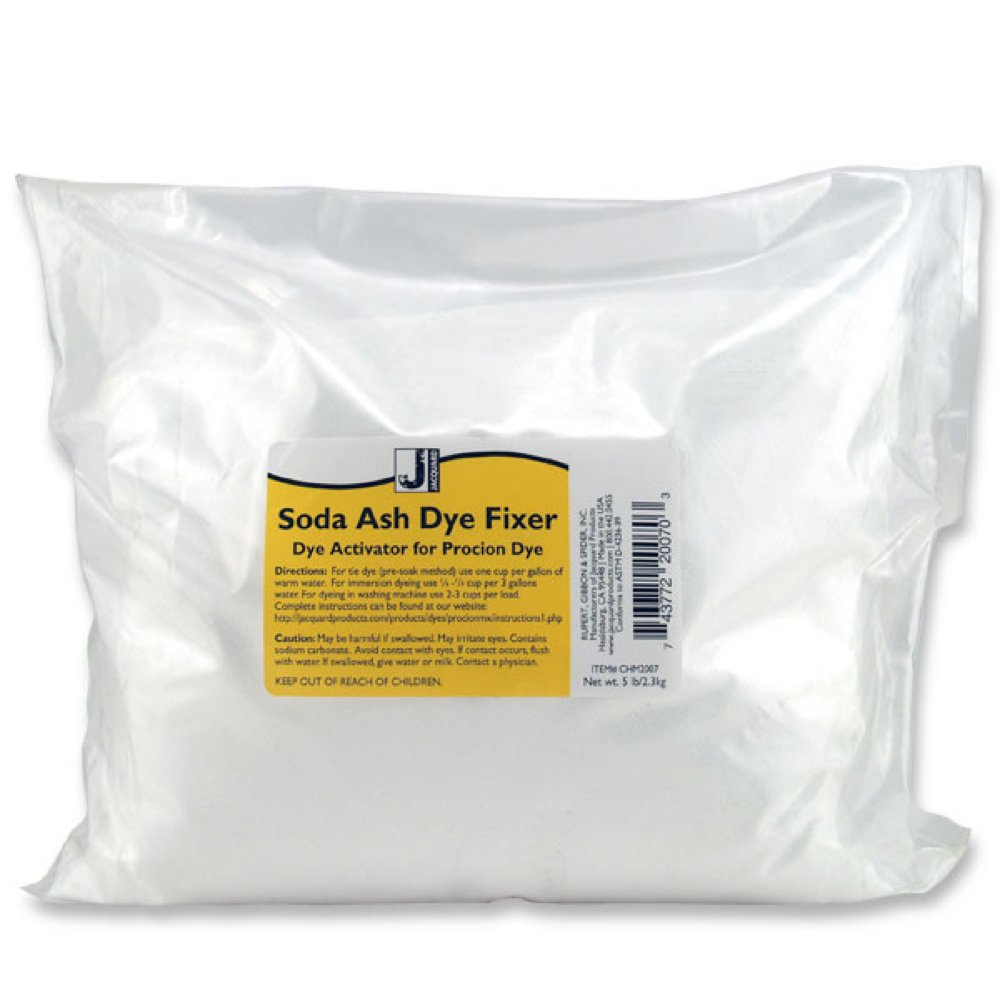
Soda ash — sodium carbonate, Na₂CO₃ — raises the pH of the fiber to somewhere between 10.5 and 11. At that pH, the cellulose in cotton and other plant-based fibers becomes chemically reactive. Procion MX and other fiber-reactive dyes contain a reactive group (a triazine ring with a chlorine atom) that, under alkaline conditions, forms a covalent bond with the hydroxyl groups on cellulose. Per PRO Chemical & Dye’s soda ash technical sheet, that covalent bond is what separates a fiber-reactive dye from a direct dye or a union dye — it’s not just sitting in the fiber, it’s chemically attached to it.
Here’s the tradeoff most intermediate dyers underestimate: soda ash works on a clock. Once you introduce soda ash to mixed dye, you’ve started a competing reaction. The activated dye can bond to the fiber — or it can hydrolyze (react with water molecules instead). Hydrolyzed dye can’t bond to anything. Dharma Trading Co.’s fiber-reactive dye instructions note that mixed Procion MX solutions with soda ash already added have a working life of roughly 1–4 hours depending on temperature, and that pre-soaking fabric in soda ash rather than mixing soda ash directly into the dye solution is the standard approach precisely because it extends your window.
Two application strategies, two different timing problems:
-
Soda ash pre-soak (most common for tie-dye and direct application): Soak fabric in a soda ash solution (1 cup per gallon of warm water is the widely cited ratio in Dharma’s instructions), wring out, then apply dye. The dye goes on already-activated fiber. You have better timing control, but you need to apply dye within a few hours of the soak.
-
Soda ash in the dye bath (immersion dyeing): Add soda ash incrementally after the dye has had time to exhaust onto the fiber. This is common in low-water immersion and vat work. The Surface Design Association’s Surface Design Journal coverage of fiber-reactive dyeing emphasizes that adding all the soda ash at once in immersion dyeing can cause uneven strike and patchy results — incremental addition over 15–30 minutes is the standard professional practice.
If you’re getting uneven color even before the wash, soda ash timing is almost always the variable to audit first.
Cure Time: The Number Most Dyers Shorten
Cure time is the window after dye application during which the bonding reaction completes. The dye is on the fiber, the alkaline environment is active, and you’re waiting for chemistry. Cut this short and you get partially bonded dye — color that looks fine wet but releases in the first wash.
By the numbers:
| Temperature | Minimum cure time | Reliable cure time |
|---|---|---|
| Below 65°F (18°C) | Not recommended | — |
| 65–75°F (18–24°C) | 18–24 hours | 24 hours |
| 75–95°F (24–35°C) | 8–12 hours | 18–24 hours |
| Batch with heat assist (95–105°F) | 4–6 hours | 8 hours |
Source: Dharma Trading Co. fiber-reactive dye instructions and Jacquard Products Procion MX FAQ, cross-referenced.
The numbers matter because temperature is the variable most dyers don’t control. Leaving a batched piece in a plastic bag in a 60°F studio in November is not the same as leaving it in a 80°F room in July. Jacquard’s Procion MX FAQ explicitly flags cold temperatures as a primary cause of washout and recommends keeping batched work above 70°F for the full cure window.
The heat assist option: Wrapping batched pieces and placing them in a warm location — near a heat source, inside a cooler with warm water bottles, or under a seedling heat mat — is a legitimate production technique for getting consistent results in variable-temperature studios. PRO Chemical & Dye’s technical documentation on fiber-reactive processes notes that some professional dye studios maintain a dedicated cure space at 80–90°F specifically for this reason. For small-batch makers running consistent colorways, that infrastructure investment pays back in predictability.
What over-curing does: Very little. A piece that batches for 48 hours instead of 24 doesn’t suffer — the excess reaction window doesn’t meaningfully degrade color. This is a one-sided risk: too short hurts you, too long doesn’t. If you’re scheduling production runs, building in buffer time is low-cost insurance.
The Wash Protocol: Where Bonded and Unbonded Dye Part Ways
Here’s a dye chemistry distinction worth internalizing: after cure, your fabric carries two kinds of dye simultaneously.
- Bonded dye: Covalently attached to the fiber. This is your permanent color. It will not wash out under normal conditions.
- Hydrolyzed/unbound dye: Floating in the fiber’s interstices. This will wash out — and if you don’t remove it properly, it will either bleed onto other fabric in future washes or create a muddy visual effect.
The wash protocol’s job is to remove the unbound dye without stressing the bonded color. The sequence that Dharma Trading Co., PRO Chemical & Dye, and Jacquard Products all converge on — with minor variations — looks like this:
Step 1: Cold rinse. Rinse the piece in cold water until the water runs mostly clear. Cold water reduces dye bleeding because it slows dye mobility. Do not wring aggressively — mechanical stress on wet fabric with loose dye can redeposit color in the wrong places.
Step 2: Synthrapol or professional scour. Synthrapol (available from Dharma, PRO Chem, and Jacquard) is a surfactant specifically formulated for removing unbound fiber-reactive dye. It keeps loose dye particles suspended in the wash water rather than letting them redeposit on lighter fabric areas. This is the step most home dyers skip — and it’s where whites go gray and light areas pick up muddiness. A small amount (1 teaspoon per gallon, roughly) in a warm-to-hot machine wash is the standard application noted in PRO Chemical & Dye’s product documentation.
Step 3: Hot wash. One full machine wash cycle at the hottest temperature appropriate for the fiber. This is not an optional step. Per Interweave’s fabric dyeing fundamentals coverage, the hot wash removes the bulk of hydrolyzed dye. Skipping it and going straight to cold leaves unbound dye in the fabric — it’ll come out in your next three home washes instead, which reads as “fading” but is actually just deferred rinsing.
Step 4: Final cold rinse or second machine wash. For production work or anything going into a retail pipeline, a second machine wash confirms the color is stable before it reaches a customer.
The tradeoff between thoroughness and time: The full four-step wash takes 45–90 minutes depending on machine cycle length. For a single art piece, that’s trivial. For a production run of 40 garments, it’s a scheduling variable. Some small-batch makers use a commercial front-loader with a dedicated rinse cycle to compress steps 1 and 3 into a single longer machine cycle. The Surface Design Association’s journal coverage notes that commercial washers with programmable cycles are increasingly common in small studio setups precisely because consistent wash protocol is a production quality control variable, not just a finishing step.
If X, Then Y: The Decision Framework
You’ve read the chemistry. Here’s how to map it to your actual situation:
If your color is washing out and you’re working in a cold studio (under 70°F): Your cure temperature is almost certainly the culprit before anything else. Audit that first. Add a heat assist solution before you change your dye concentration or soda ash ratio.
If your cure environment is warm but you’re still losing color: Check your soda ash application method. If you’re mixing soda ash into the dye solution rather than pre-soaking the fabric, you’re likely working with a high proportion of hydrolyzed dye before the dye even hits the fiber. Switch to pre-soak method and retest.
If your final color is muddy or your whites are graying: Your wash protocol is incomplete. Add Synthrapol to your wash step and confirm you’re doing a hot wash. The color is there — it’s just buried under unbound dye residue.
If you’re running consistent production colorways and getting batch-to-batch variation: Temperature and timing inconsistency across batches is the most common culprit. Standardize cure temperature (not just time), use a thermometer, and document your process the way you’d document a dye formula. Variation in any one variable compounds with variation in others.
If everything looks right but you’re still getting washout after multiple cycles: Verify your fiber content. Fiber-reactive dyes work on cellulose (cotton, linen, rayon, bamboo, hemp) and do not bond to polyester or most synthetics regardless of soda ash or cure time. A cotton-poly blend dyed with Procion MX will show the cotton portion holding color while the poly fibers bleed pale — and no protocol adjustment fixes a fiber-dye compatibility mismatch. Jacquard’s iDye Poly line, formulated specifically for synthetic fibers, is the separate product category for that use case.
The protocol that actually works isn’t a secret — it’s just three variables held simultaneously: alkalinity, time, and wash thoroughness. Optimize any one without the other two and you’re leaving color on the table.