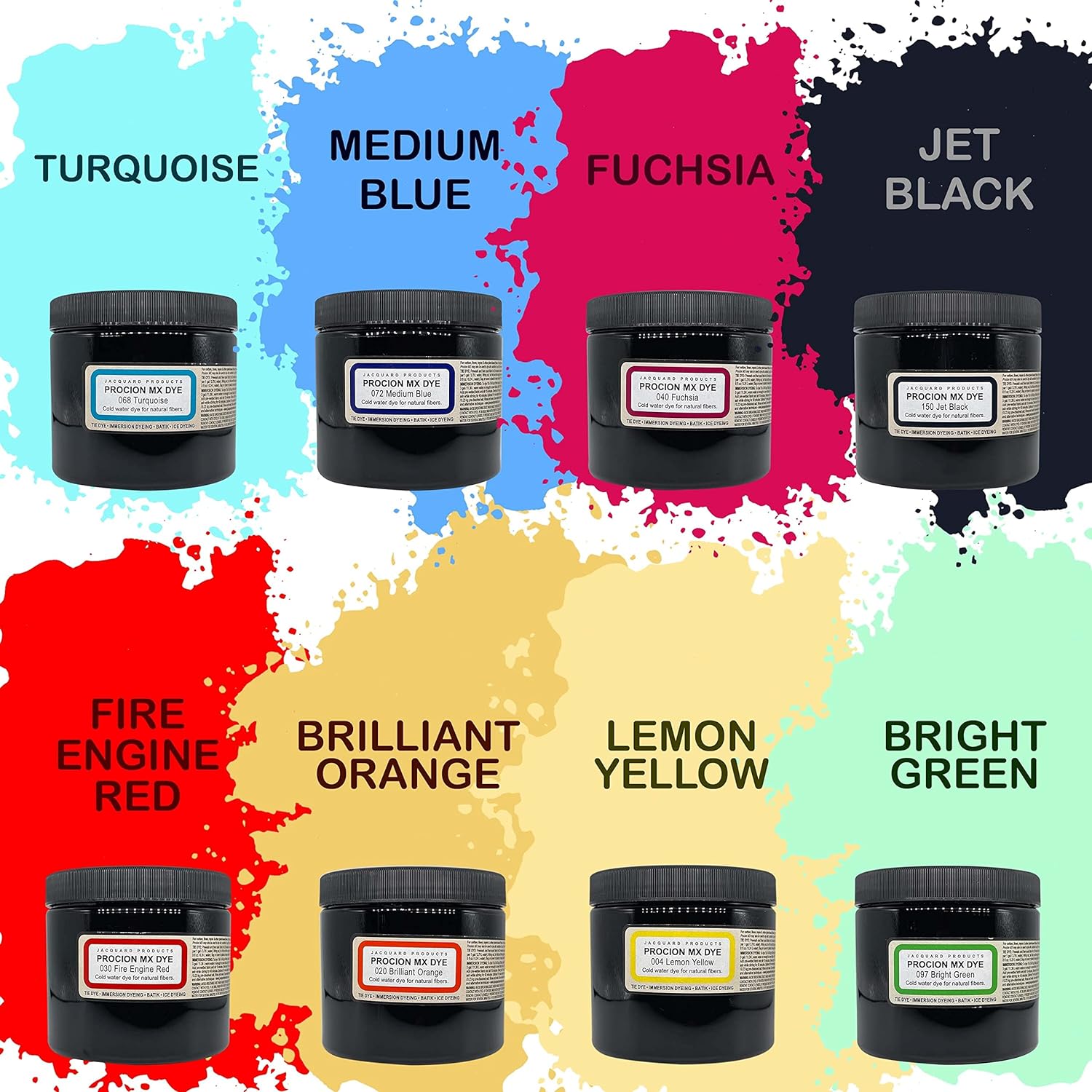
If you’ve ever done a big fiber-reactive dye project — the kind where you’re mixing multiple colors into a large wash basin to color a pound or more of cotton, linen, or rayon — you’ve probably noticed the 2/3 oz jar of Procion MX powder disappearing faster than you expected. Procion MX (pronounced “pro-see-on”) is a class of fiber-reactive dye, meaning it forms a permanent chemical bond directly with natural plant fibers like cotton and linen rather than just coating the surface. That bond is what makes colors so wash-fast and bright. The powder comes in many container sizes, from small 2/3 oz (roughly 19g) retail jars up through 1 lb, 2 lb, and even 5 lb bulk bags. Choosing the wrong size for how much you actually dye isn’t just a minor inconvenience — it quietly inflates your cost-per-project and can affect color consistency across batches. This guide walks through exactly when and why to move up, with the math to back it up.
| EDITOR'S PICK[Procion MX Dye Color Set](https://www.amazon.com/dp/B07THBY8Z8?tag=greenflower20-20) | Mid-tier[Jacquard Procion Mx Dye - Undis…](https://www.amazon.com/dp/B09HRFNMV3?tag=greenflower20-20) | Budget pick[Procion Mx Dye Jet Black 8Oz](https://www.amazon.com/dp/B0009YX4EG?tag=greenflower20-20) | |
|---|---|---|---|
| Weight per color | 2/3 oz | 1 lb | 8 oz |
| Colors included | 13 | — | — |
| Soda ash included | ✓ | — | — |
| Instruction sheet | ✓ | — | — |
| Color chart | ✓ | — | — |
| Made in USA | — | ✓ | — |
| Price | $69.99 | $34.99 | $22.99 |
| See on Amazon → | See on Amazon → | See on Amazon → |
The Real Cost of the 2/3 oz Jar
Let’s start with the number most people skip: cost per gram of dye powder.
At current 2026 pricing, the retail 2/3 oz (19g) Procion MX jars from Dharma Trading Co. typically run $3.89–$4.49 depending on color. That works out to roughly $0.21–$0.24 per gram. The same color in a 1 lb (454g) bulk bag runs approximately $20–$28, landing at $0.04–$0.06 per gram — a reduction of 75–80% per gram of dye.
By the numbers:
| Size | Approx. Price | Cost Per Gram |
|---|---|---|
| 2/3 oz jar (~19g) | $3.89–$4.49 | ~$0.21–$0.24/g |
| 1 lb bag (454g) | $20–$28 | ~$0.04–$0.06/g |
| 2 lb bag (908g) | $36–$50 | ~$0.04–$0.06/g |
(Prices sourced from Dharma Trading Co. product listings, May 2026)
The per-gram cost difference is dramatic. But the trap is buying bulk powder you won’t use before it degrades — and Procion MX absolutely does degrade. PRO Chemical & Dye’s dye calculation reference notes that fiber-reactive dyes, once exposed to humidity and heat, begin to hydrolyze (bond with water molecules rather than fiber, rendering them inactive). An opened bag kept in a warm, damp studio can start losing exhaustion rate — the percentage of dye that actually bonds to fiber — within a few months. A sealed, dry bag stored in a cool environment has a useful shelf life of 1–2 years or longer.
So the real question is: how much dye do you actually move in a year?
How Much Dye Do You Actually Use Per Batch?
Before you can answer the sizing question, you need to understand standard dye concentrations — because “I use a little bit each project” doesn’t translate until you know what “a little bit” actually means by weight.
Fiber-reactive dye concentration is calculated as a percentage of the dry weight of fiber (DWF or OWF — “on the weight of fiber”). The Surface Design Association’s studio practice resources consistently reference these standard ranges for Procion MX on cotton:
- Pale/pastel shades: 0.5–1% OWF
- Medium shades: 2–3% OWF
- Deep, saturated shades: 4–6% OWF
- Black and navy (full exhaust): 6–8% OWF
What that means in practice: dyeing 1 lb (454g) of cotton fabric to a medium teal requires roughly 9–14g of dye powder. Dyeing a deep black on the same pound of fabric requires 27–36g of powder. If you’re running that deep black regularly, you’ll burn through a 19g jar in a single dye bath — and then need another jar just to finish the exhaust.
For someone doing 2–3 dye sessions per month on half-pound to full-pound fiber batches in medium shades, a rough annual dye consumption estimate for any single color runs 100–300g per year. At that rate, the 1 lb bulk bag is the right unit — you’ll use it within the safe shelf-life window, and the savings are real.
For someone dyeing 4–6 lb batches weekly in saturated colors — a small production studio, a seasonal collection maker — annual consumption per workhorse color like black or navy can easily reach 1–2 lb per color, per year. The 2 lb bag or even larger becomes the logical unit, with meaningful additional savings on shipping cost per ounce.
The Color Consistency Argument for Bulk
Here’s the angle that production-scale makers often name first — and it’s separate from the cost question entirely.
When you buy Procion MX in 2/3 oz retail jars across multiple purchase dates, you’re drawing from different production lots. Dye powder manufacturers including Jacquard Products and PRO Chemical & Dye note that while Procion MX formulations are standardized, slight lot-to-lot variation in dye strength (exhaustion rate) can occur. In practice this means a jar of Fuchsia MX-8B purchased in January may dye slightly more intensely per gram than a jar purchased in October, even at identical concentration percentages and conditions.
For hobbyists and occasional dyers, this is mostly academic — the difference is subtle and human perception of “close enough” is generous. But for indie apparel brands and production makers trying to match colorways across a 40-piece seasonal run, that subtle drift is a real problem. Running the entire production from a single 2 lb bag of each core color eliminates the lot-variation variable. Dharma Trading Co.’s bulk listings explicitly note lot numbers for professional buyers for exactly this reason.
This is also why intermediate practitioners working toward consistent, repeatable results should track lot numbers even when buying 1 lb bags — write the lot on the bag in permanent marker when it arrives, and note it in your dye journal alongside your results. It’s the kind of small discipline that pays off when you’re trying to recreate that perfect dusty sage six months later.
When the Small Jar Is Still the Right Call
It would be dishonest to frame this as “bulk always wins.” There are legitimate scenarios where the 2/3 oz jar remains the smarter purchase.
You’re color-exploring. If you’re building out your color library and not yet sure which hues will anchor your palette, buying 8–12 small jars to audition colors makes more sense than committing $25 to a pound of a color you’ll dye with twice and shelve. Jacquard Products’ retail jar lineup is specifically well-suited to this — it’s a low-risk way to build intuition about which colors you actually reach for.
You dye infrequently in small batches. If you’re doing one meaningful dye project per month on half a pound of fiber in light-to-medium shades, annual consumption per color may be only 20–50g. Buying a 1 lb bag means you’re likely to hit the end of the bag’s safe storage life before you finish it — especially if your studio isn’t climate-controlled. In that case, the small jar’s higher per-gram cost is actually the honest cost of not wasting degraded powder.
You need an unusual color infrequently. That one specialty mixing color you use twice a year — say, a turquoise or a yellow that you blend into a custom orange — probably belongs in the small jar category even after you’ve gone bulk on your workhorse colors.
The decision framework here is straightforward: if you project consuming more than 100g of a given color per year, under proper storage conditions, the 1 lb bag is almost certainly worth it on cost alone, before factoring in consistency benefits.
Storage Is the Hidden Variable That Changes the Math
No discussion of bulk sizing is complete without addressing storage, because improperly stored bulk powder can flip the economics entirely.
PRO Chemical & Dye’s documentation on MX series dyes recommends airtight containers, low humidity (below 50% relative humidity where possible), and cool temperatures — ideally below 70°F (21°C). Heat and moisture are the enemies. A resealable foil Mylar bag or a sealed HDPE plastic container with a desiccant packet extends usable life significantly compared to leaving the original paper bag folded over and clipped.
Practically speaking: if your studio is a garage in a humid climate, your effective shelf life for opened powder is shorter than someone working in a climate-controlled basement. That changes the math on how large a quantity makes sense. A dyer in coastal Georgia buying 2 lb bags of colors they use slowly is likely wasting more powder to degradation than they’re saving on per-gram cost. A dyer in a dry Colorado studio with proper containers can comfortably run 2 lb bags on workhorse colors and see the full cost savings.
The Surface Design Association’s studio practice resources specifically call out that buying more dye than your storage conditions can protect is one of the most common sources of inconsistent results among intermediate fiber artists moving into larger batch work — colors that seem to pull weaker than expected are often partially hydrolyzed powder, not a technique error.
The Decision Rule
If your situation matches one of these profiles, here’s the clear call:
If X, then Y:
-
If you’re using any single color more than twice a month in medium-to-deep shades on batches of half a pound or more → move to the 1 lb bag. The cost savings are real, the consistency payoff is real, and you’ll turn through the stock inside the safety window.
-
If you’re running a repeating colorway across a production run of 20+ pieces in any one season → 2 lb bag minimum on each core color. Lot consistency matters more than per-gram price at this point, but the per-gram savings are a bonus.
-
If you’re color-exploring or dyeing fewer than 50g of any color per year → stay with the small jar. Protecting your cash and avoiding degraded powder is the right priority.
-
If your storage situation is high-humidity or uncontrolled temperature → apply a 30–40% haircut to whatever consumption threshold you’d otherwise use. The small jar stays economical longer when powder can’t be stored properly.
The honest summary: the 2/3 oz jar is a good product for the right use case. It stops being the right use case the moment you find yourself opening a second jar mid-batch. That’s the clearest signal your project scale has outgrown the retail size — and the math, on any color you reach for consistently, will confirm it quickly.