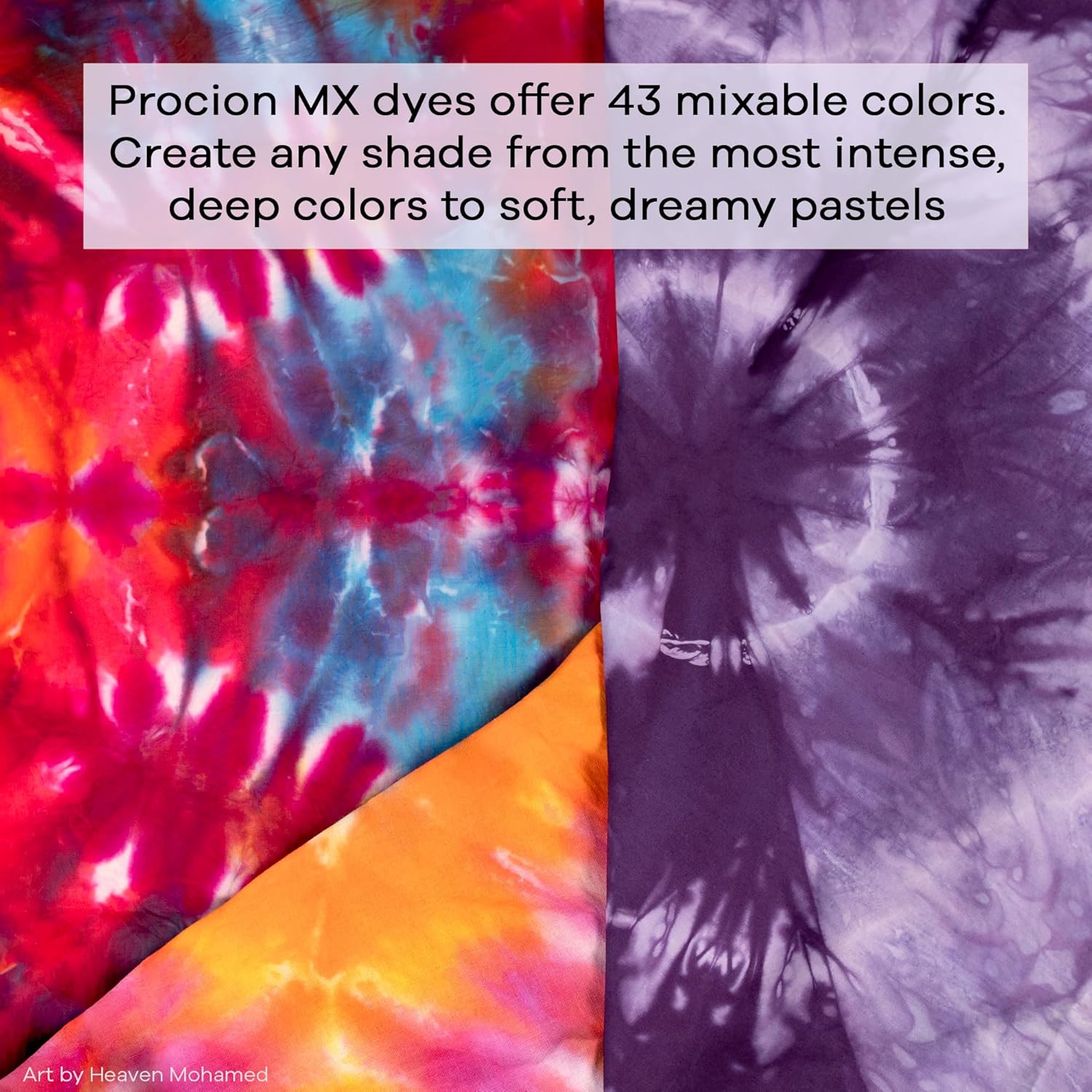
Ice dyeing is exactly what it sounds like: you pile ice on top of fabric, sprinkle powdered dye over the ice, and let the whole thing melt slowly over several hours. As the ice melts, it carries dissolved dye down through the fabric in unpredictable rivulets, leaving behind a marbled, watercolor-like pattern with hard edges, soft gradients, and surprising color interactions. It looks almost accidental — and that’s part of the appeal. But if you’ve done a round or two and ended up with muddy browns where you expected vivid teals, or flat color instead of the fractal patterning you were hoping for, you’ve already figured out that there’s more going on under the ice than randomness. This guide is for that moment: once you want to understand the system well enough to guide the results, even when the process stays beautifully unpredictable.
We’re focusing specifically on Procion MX dyes (fiber-reactive dyes — a class that bonds chemically to natural fibers like cotton, linen, and rayon rather than just sitting on the surface) because they’re the overwhelming choice for serious ice dyeing. The fiber-reactive bond is what gives ice-dyed fabric its colorfastness — colors that hold through washing rather than fading out after the first few cycles. If you’re working with Jacquard Procion MX, Dharma Trading Co.’s house Procion MX formulas, or PRO Chemical & Dye’s MX-series powders, everything below applies to your setup.
Why Soda Ash Placement Changes Everything
Here’s the decision that most intermediate ice dyers are wrestling with: do you soda-ash the fabric before dyeing, or do you add soda ash to the ice pile during the dye application?
Both approaches work. They produce different results. Understanding why lets you choose deliberately.
Soda ash (sodium carbonate) is the alkaline fixative that raises the fabric’s pH high enough for Procion MX to bond covalently — meaning the dye molecule actually attaches to the cellulose fiber, rather than washing out. Without it, you get color, but not durable color. Per the PRO Chemical & Dye Fiber Reactive Dye Technical Bulletin, the ideal pH range for Procion MX fixation is approximately 10.5 to 11. Soda ash solution hits that range reliably.
Pre-soaking in soda ash solution (the standard method Dharma Trading Co. describes in their Procion MX instructions) means your fabric is already activated before the ice goes on. The dye, as it melts through, encounters fiber that’s ready to bond immediately. This tends to produce:
- Sharper color breaks and more defined edges
- Stronger saturation in areas of heavy dye concentration
- Less color travel, because the dye bonds quickly before migrating far
Adding soda ash crystals or powder to the dye pile on top of the ice gives the dye more time to migrate across the fabric surface before fixation kicks in — the alkaline environment develops gradually as the crystals dissolve into the meltwater. This produces:
- Softer, more blended gradients
- More color-mixing in overlap zones (which is where secondary and tertiary colors emerge from your primary powders)
- Higher risk of muddy overlap if your color choices aren’t complementary
The Surface Design Association’s Surface Design Journal has covered ice dyeing technique in depth, noting that the timing and placement of the alkali activator is the single variable most practitioners underestimate in its effect on final texture.
The practitioner decision rule: If you’re aiming for high-contrast, fractal-edged patterns with clean color separations, pre-soak. If you’re after watercolor bleed and softer transitions, layer soda ash crystals into your ice pile. Don’t mix methods on the same piece unless you’re testing intentionally — the results become hard to read and harder to repeat.
Setting Up the Ice Dye Rack: What Actually Matters
The physical setup sounds simple — fabric on a rack over a container, ice piled on top, dye applied — but the geometry of your setup directly influences how dye distributes.
The rack height and container clearance. You need the fabric suspended well above the bottom of the catch container so meltwater drains away from the fabric rather than pooling back up into it. If dye-saturated meltwater sits in contact with your fabric for hours, it floods into areas you didn’t intend and washes out the pattern edges. Aim for at least 3–4 inches of clearance. A simple wire cooling rack over a storage tote is the workhorse setup that most practitioners use; the tote catches meltwater cleanly.
Fabric prep and folding. Wet fabric before placing it on the rack. Dry fabric repels early meltwater slightly, and the first melt is your most concentrated dye delivery — you want it to penetrate immediately. Pre-wetting also lets the fabric compress into your folds more evenly. Speaking of folds: the pattern in your finished piece is mostly determined by how you arrange the fabric on the rack, not by the dye placement. Scrunching versus accordion-folding versus pleating gives you fundamentally different texture architectures.
Ice type and quantity. Standard cube ice from a bag works fine, but crushed ice melts faster and produces more flowing, blended results because it releases water quickly across a larger surface area. Larger cubes melt slowly and let individual dye powders stay concentrated in their application zone longer before the colors have a chance to mix. Dharma Trading Co.’s guidance on ice dyeing notes that cube size is a legitimate texture variable — not just a convenience choice.
Dye powder application density. This is where most practitioners over-apply. Procion MX is concentrated; the powder-to-water ratio when it melts is much higher than in a typical squirt-bottle application. A light dusting of powder over a section of ice delivers more color than it looks like it will. Heavy application in a single zone creates an oversaturated patch that often reads as a dark, slightly murky blotch rather than a rich saturated color. The Jacquard Products Procion MX information sheet notes that color value (the depth of shade) scales with dye concentration but has a ceiling past which additional dye doesn’t fix — it just washes out.
By the Numbers:
| Variable | Faster Melt Effect | Slower Melt Effect |
|---|---|---|
| Ice type | Crushed (blended, soft edges) | Cube (defined, slower migration) |
| Soda ash timing | In ice pile (gradual activation) | Pre-soak (immediate fixation) |
| Dye powder density | Light dusting (cleaner color) | Heavy application (risk of mud) |
| Ambient temperature | Warm room (faster, less time to fix) | Cool room (slower, more migration) |
Why Color Migration Isn’t Random — and How to Work With It
This is the chemistry piece, and it matters practically.
Procion MX dyes don’t all migrate at the same rate. Different MX dyes have different molecular weights and different substantivity (the technical term for how strongly a dye molecule is attracted to fiber before fixation). In ice dyeing, where dye is dissolved slowly in a small amount of cold meltwater and pulled through fabric by gravity, these differences become visible. Lighter, smaller dye molecules travel farther from the application point. Heavier or more substantive molecules stay close to where the powder landed.
This is why some colors “halo” and others sit tight. It’s also why certain color combinations almost always produce unexpected intermediates: you’re not fully controlling where each dye ends up relative to the other, so overlap zones generate whatever secondary color results from that combination.
The practical implications:
Yellow dyes tend to travel. Most yellow Procion MX formulations (including the yellows in Dharma’s line) are lower-molecular-weight dyes that spread readily in cold water. If you place yellow powder adjacent to blue, expect the yellow to migrate into the blue zone and create green halos before the blue has moved at all.
Turquoise (Procion MX Turquoise, also labeled MX-G in some formulations) is notorious for migrating. PRO Chemical & Dye’s technical documentation specifically notes that turquoise has different exhaustion characteristics than most other MX dyes. In ice dyeing, it tends to travel significantly from its application point. This is actually beautiful if you account for it — turquoise placed near warm colors will reach into them and create sea-green transitions without any blending on your part.
Red and magenta dyes sit tighter. Most red-spectrum MX dyes have higher substantivity, meaning they bond more readily to fiber close to the application point and don’t migrate as far. This makes them useful as anchors: placing red or magenta at the center of a design area tends to hold its position while other colors drift around it.
If X, then Y — the practitioner decision rules:
- If you want clean, saturated primaries with minimal color mixing: pre-soak in soda ash, use large cube ice, apply dye sparingly in separated zones with space between colors.
- If you want rich color-mixing and gradient intermediates: use crushed ice, add soda ash to the ice pile, and deliberately place migrating dyes (yellows, turquoise) adjacent to the colors you want them to blend into.
- If you’re getting muddy browns or grays in your overlap zones: you’re likely combining dyes that sit at opposite ends of the color wheel without enough space between them. Red + green, or orange + blue, will go brown in overlap. Review your color placement and add more physical separation, or pre-soak to limit migration.
- If your colors are washing out in the first rinse: fixation failed. Check your soda ash concentration (standard is 1 cup per gallon of water for pre-soak, per Dharma Trading Co.’s soda ash instructions), your cure time (most practitioners cure at room temperature for 12–24 hours minimum, or 4–6 hours in a warmer environment), and your fiber content — Procion MX doesn’t bond to synthetic fibers or protein fibers like wool without modification.
- If your piece looks flat and uniform instead of textured: the fabric wasn’t folded or scrunched enough, or the ice melted too quickly and flooded the fabric evenly. Add more fabric manipulation before the ice goes on, or move your setup to a cooler space to slow the melt.
The Fiber Composition Question
Procion MX is a cellulose-reactive dye. It bonds to cotton, linen, rayon, hemp, bamboo-viscose, and other plant-derived fibers. It does not bond to polyester, nylon, or acrylic. It bonds to wool and silk only under modified conditions (lower pH, different fixation approach) — the standard soda ash ice dyeing process is too alkaline for protein fibers and can damage them.
For ice dyeing specifically: 100% cotton or rayon gives you the most saturated, high-contrast results. Cotton-linen blends work well. Bamboo-viscose is increasingly popular because its slightly looser fiber structure produces especially soft color gradients. If you’re working with a cotton-poly blend, only the cotton content will take the dye — you’ll get a heathered, muted result rather than full saturation. That’s not wrong, but it’s a different result, and it’s worth knowing before you commit 30 yards of blended fabric.
The Surface Design Association’s coverage of fiber-reactive dyeing consistently emphasizes fiber content verification as the first step in any dye project — not because it’s complicated, but because it’s the variable most likely to explain unexpected results when everything else was done correctly.
Ice dyeing rewards the practitioners who treat the process as a system with controllable inputs rather than pure chance. The variables are real, the chemistry is consistent, and once you can name what’s driving each effect, you can start making intentional choices about which kind of beautiful unpredictability you’re inviting in.