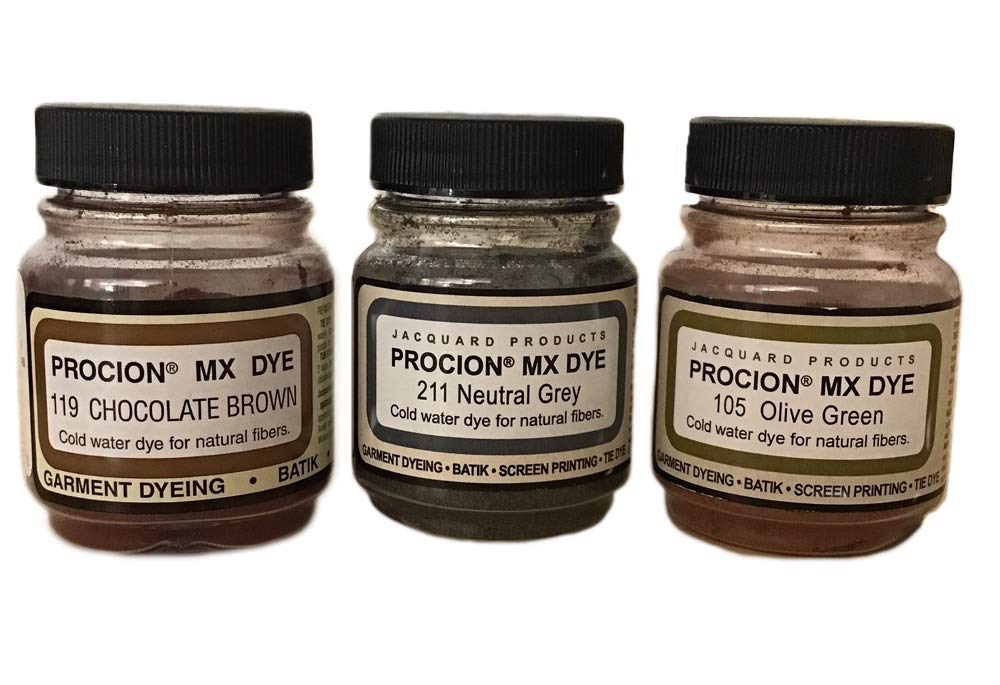
Earth tones — the warm browns, deep rusts, and quiet mossy olives you see in handmade textiles — look like they should be easy to produce. They’re literally dirt colors. But if you’ve spent any time mixing dyes on cellulose fabric (cotton, linen, rayon, or hemp), you’ve probably run into the frustrating version: a color that looked rich in the dye bath and came out of the wash looking flat, grayish, or just generally sad. That’s the muddy-earth-tone problem, and it’s almost never the dye’s fault. It’s a mixing and process decision. This article is a decision guide for intermediate dye practitioners who want a reliable, repeatable earth tone palette using fiber-reactive dyes — the kind that bond chemically to natural fibers and produce washfast color — without starting from scratch every time.
Why Earth Tones Go Muddy (and What’s Actually Happening)
The short version: earth tones are tertiary or quaternary mixes. Brown isn’t a single pigment or dye molecule — it’s what happens when you combine complementary colors (opposites on the color wheel) or mix three or more primaries in unequal ratios. That’s fine. The problem is that fiber-reactive dyes don’t all bond at the same rate or under the same pH conditions. When you’re mixing a dye bath with, say, a warm red, a yellow, and a touch of blue, those three dyes are competing for reactive sites on the fiber. If one exhausts faster than the others — or if your soda ash (the alkali fixative that triggers the dye-fiber bond) drops in at the wrong moment — the color you get on the fiber is a different ratio than the one you mixed in the bucket.
The practical implication: muted, dirty results are often a process problem, not a color-theory problem. Dyer and surface design educator resources from Dharma Trading Co.’s Procion MX Dye Color Mixing Guide specifically note that earth tones require attention to dye class compatibility within a single bath, because some Procion MX colors (particularly turquoise MX-G and certain blacks) have significantly different exhaustion rates than warm yellows and reds. Mix those together without accounting for it and you get a color drift toward gray or green as the faster-bonding dye outcompetes the others.
The fix is to work with dyes that have comparable exhaust rates — or to accept that you’ll be building earth tones from a two-step layered process rather than a single bath.
The Three Mix Strategies for Browns, Rusts, and Olives
Strategy 1: Complementary Pair + Depth Modifier
This is the workhorse approach. Pick a warm complementary pair — orange and blue, or red-orange and blue-green — and mix them in an unequal ratio (roughly 70/30 or 80/20) to land on a muted brown. Then use a small amount of a depth modifier (a stronger version of the dominant color, or black in very small doses) to push value lower.
Per the PRO Chemical & Dye technical bulletin on fiber-reactive color mixing, the most reliable starter pairs for warm brown on cotton are:
- Procion MX Sun Yellow (MX-8G) + Mixing Blue (MX-R) in a 3:1 ratio gets you into the khaki-to-tan range; adding a small percentage of Mixing Black shifts it toward a medium walnut brown.
- Golden Yellow (MX-3RA) + Navy Blue at 2:1 produces a richer, more saturated brown with a warm cast.
For rust, the framework shifts. You’re not trying to neutralize — you’re amplifying red-orange warmth while pulling back saturation just enough that the color reads as earthy rather than neon. The PRO Chemical & Dye bulletin recommends starting with a red-orange base (Procion Red MX-5B plus Sun Yellow in roughly 1:2 ratio) and adding a very small amount of black — no more than 3–5% of total dye weight — rather than its complement, which would push it toward brown too quickly.
Olive is arguably the trickiest of the three. It’s a warm-biased yellow-green, but it needs just enough red to kill the brightness that makes yellow-greens look artificial. The Surface Design Association’s journal on fiber-reactive color theory notes that olive made with straight Procion yellow-green (MX-CBA or similar) plus red tends to shift toward khaki or army green depending on the red percentage. The more reliable path: start with a mid-range yellow (not the brightest), add a small amount of a blue-green (not pure blue), then neutralize with 5–8% warm red. The layered warm undertone is what separates a good olive from a swamp green.
Strategy 2: Pre-Mixed Earth Tone Concentrates as Anchors
If you’re running a production colorway and need consistency across multiple batches, mixing earth tones from scratch in a three-dye bath introduces too many variables. In this case, practitioners commonly anchor the bath with a pre-mixed brown or earth concentrate and adjust from there.
Dharma Trading Co.’s bulk Procion MX line includes Brown MX-GRN and a tan/camel option that practitioners use as anchors. Jacquard’s Procion MX line includes Warm Brown and Rust as named colors. These aren’t as flexible as your own mixes, but they exhaust predictably because they’re pre-balanced. Reviewers across dye-focused textile forums and the Interweave editorial archives consistently note that for small production runs where dye-lot consistency matters, starting from a named earth-tone concentrate and shifting it 10–15% with a secondary dye gives more batch-to-batch reliability than building from primary scratch every time.
The tradeoff: you’re giving up some control over undertone. A pre-mixed brown is already balanced for someone else’s idea of brown. If your brand palette runs warm-amber or leans toward a clay-red, you’ll be fighting the base rather than building on it.
Strategy 3: Low-Water Immersion or Sequential Overdyeing
For shibori, low-water immersion, or any technique where the dye concentrations vary across the cloth, sequential dyeing — dyeing a pale yellow base first, fixing and washing it, then overdyeing with a blue-green — produces an olive with more visual depth than a single bath mix. The reason is physical: the two dye layers interact optically, not chemically, and the result is a color that shifts slightly depending on light angle and cloth texture. This is the approach that makes a lot of handmade earth-tone textiles look “richer” than flat yardage — it’s not a single flat color, it’s two stable transparent layers reading as one.
The cost to this approach is time and water: two full dye cycles, two soda ash fixation periods, two wash-outs. For a production context that’s often prohibitive. For studio yardage or one-of-a-kind work, it’s worth the investment.
By the Numbers: Earth Tone Mix Ratios as a Starting Point
These are research-derived starting ratios from Dharma Trading Co.’s mixing guide and the Jacquard color reference — not absolute formulas, since water hardness, fabric weight, and dye lot age all affect results. Use them as a calibration starting point.
| Target Color | Primary Dye | Secondary Dye | Modifier | Starting Ratio |
|---|---|---|---|---|
| Warm Brown | Golden Yellow MX-3RA | Mixing Blue MX-R | Black (optional) | 60 / 35 / 5 |
| Rust | Red MX-5B | Sun Yellow MX-8G | Black | 40 / 55 / 5 |
| Olive | Sun Yellow MX-8G | Turquoise MX-G | Warm Red | 55 / 30 / 15 |
| Clay/Terracotta | Orange MX-2RA | Mixing Blue MX-R | — | 80 / 20 / 0 |
Process Variables That Make or Break Earth Tones
Soda Ash Timing
For earth tone mixes, pre-soaking the fabric in soda ash solution (rather than adding soda ash directly to the dye bath) is the more reliable approach. Pre-soaking gives the fiber a uniform alkaline state before the dye touches it, which means all three dyes in your mix encounter the same bonding conditions at the same time. Adding soda ash mid-bath — a technique that works well for single-dye immersion — creates a wave of reactivity that faster-bonding dyes exploit ahead of slower ones, which is exactly the mechanism that turns an intended brown muddy.
PRO Chemical & Dye’s technical bulletin recommends a 30-minute pre-soak in a 1-cup-per-gallon soda ash solution for cotton and rayon when working with multi-dye earth tone baths.
Temperature and Cure Time
Room-temperature dyeing (65–75°F / 18–24°C) gives slower, more even exhaustion — which is what you want for complex mixes. Warm-water baths (95–105°F) accelerate exhaustion unevenly across dye types. For earth tones specifically, the Jacquard Procion MX color reference notes that turquoise and blue-greens are particularly sensitive to temperature acceleration, and they’ll dominate a warm bath in ways that push your brown toward olive or your rust toward brick-red.
Cure time matters too: 24 hours at room temperature, or 4–6 hours in a warm (not hot) environment. Under-cured earth tones frequently wash out lighter and more muted than expected — not because the color was wrong, but because the bond didn’t complete.
Urea and Liquor Ratio
Urea (a humectant — a substance that keeps fabric moist longer) is worth including in earth tone baths at 1–2 tablespoons per cup of dye concentrate. Per the Surface Design Association’s journal, urea extends the dye’s working time and helps ensure complete exhaustion of slower-bonding components in the mix. This is especially useful in dry studio conditions or when working with heavier fabric weights (canvas, thick twill) where dye penetration takes longer.
Decision Frame: Which Approach for Your Situation
If you’re mixing earth tones for one-of-a-kind studio work and you want visual depth and complexity: the sequential overdye strategy (Strategy 3) is worth the extra process time. You’ll get colors that look genuinely handmade rather than flat.
If you’re running small production batches (say, 10–30 yards for a seasonal collection) and batch consistency is the priority: anchor with a pre-mixed earth concentrate and shift it within 15% using secondaries. Test-dye a 1-yard sample, document your exact gram weights and ratios, and you’ll have a reproducible formula.
If you’re learning earth tone mixing and want to understand the color logic before buying concentrates: work from Strategy 1 (complementary pairs) with a small swatch kit. Two or three rounds of 8-inch swatches at different ratios costs almost nothing in dye and teaches you more about your specific dye brand’s behavior than any formula chart can.
The muddy-earth-tone problem is solvable — it just requires treating multi-dye baths with the same care you’d give a dye-by-number single-color project. The chemistry hasn’t changed; what changes is how many variables are running simultaneously. Control those variables, and the colors you’re after are genuinely achievable with standard Procion MX stock.